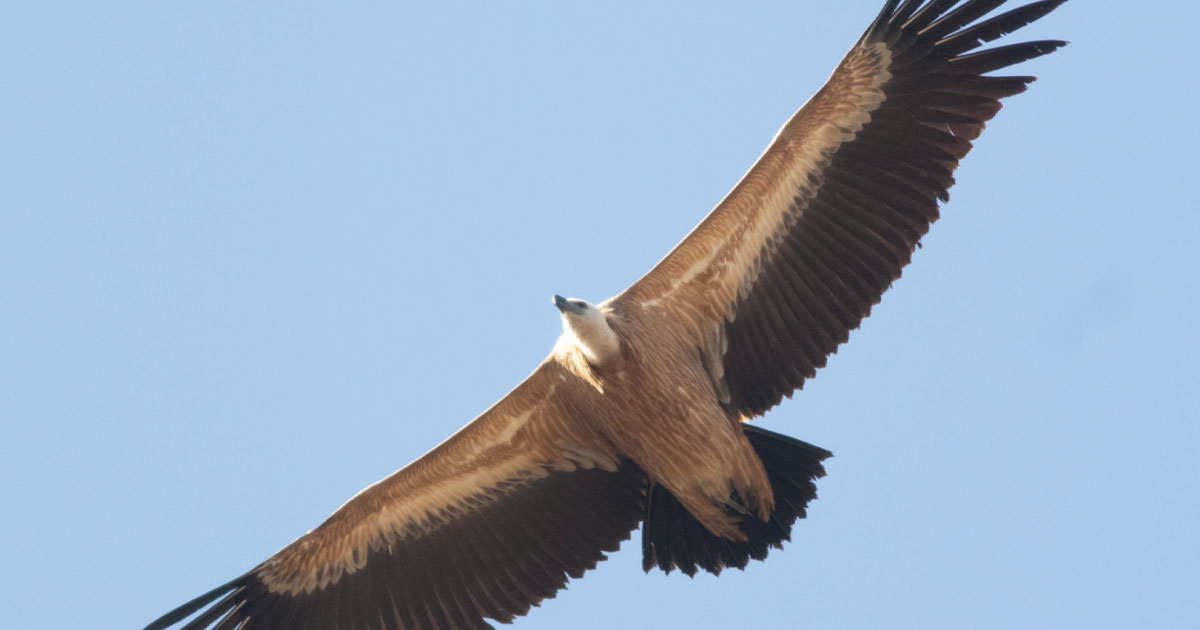
In February 2022, there are ten pairs of Griffon vultures building nests in the Kresna Gorge. Оптимистичните новини идват заедно с излизането на отчета за реинтродукцията на лешоядите за 2021.
The Report on the twelfth year of the Griffon Vulture Gyps fulvus reintroduction into Kresna Gorge, which started in 2010, is part of the report of Action D2 of the project “Vultures Back to LIFE” LIFE14NAT/BG/649”.
After the mass poisoning incident in March 2017, the colony of the Griffon Vultures in Kresna Gorge slowly recovered and this process continued through 2021. For the control and prevention of poisoning a massive use of high definition and intensive data collecting and loading satellite transmitters are on-going.
Highlights from the reintroduction process of the Griffon Vulture in Kresna Gorge for 2021 are as follows:
1.) Two pairs of Griffon Vultures successfully raised young.
2.) The exchange of individuals between the colony of the species in Demir Kapia – North Macedonia and Kresna Gorge continued – supporting the theory that the two sites are parts of a common Vulture Key Area in the Balkans;
3.) More than 100 individually recognized Griffon Vultures visited Kresna Gorge in 2021;
4.) Three Cinereous Vultures (Aegypius monachus) and four Egyptian Vultures (Neophron percnopterus) were observed in Kresna Gorge in 2021.
In 2021, marked Griffon Vultures from Israel, Greece, Serbia, Croatia, Italy, and other parts of Bulgaria (including Eastern Rhodopes, Eastern Balkan Mountains, and Vrachanski Balkan) were again observed in Kresna Gorge. Individuals released or captured and marked in Kresna Gorge were observed in Serbia, Israel, Turkey, Greece, Northern Macedonia, Austria, Italy, France, Egypt, Syria, Iraq, Iran, Saudi Arabia, Jordan, Lebanon, and Yemen as well as in other parts of Bulgaria (Vrachanski Balkan, Sinite Kamani, Kotel, and Eastern Rhodopes).
For the first time, a wild-caught and tagged Griffon Vulture in Kresna Gorge migrated towards France but lost its transmitter in the area of Verdon. In this area, a reintroduction program for Griffon and Cinereous Vultures has been running for more than 20 years and as a result, a local colony exists.
The Griffon Vultures from Kresna Gorge were again observed in the Rila and Pirin Mountains during the summer months of 2021.
The maintenance of the feeding site of the vultures continued in 2021 with over 34 tons of carcasses provided in 147 feeding events. Other activities to prevent conflict between livestock breeders and predators, and activities to increase wildlife and extensive livestock breeding continued.
The FWFF’s nature conservation activities in the area continued under the “Bright future for the Black Vulture” – LIFE14 NAT/BG/649 project, under the leadership of Green Balkans – Stara Zagora, funded by the EU LIFE Financial Instrument, in cooperation with Vulture Conservation Foundation, EuroNatur, and Gobierno de Extremadura. The FWFF’s activities are also co-funded by the Bioparc de Doue Conservation, Naturschutz-Tierpark Görlitz and Sainte Croix Conservation.